How’s This for Speaking Your Truth?

Lady Gaga is nothing if not true to herself – who else would show up for yoga class clad in such an uncomfortable-looking getup? I would find this a little too chafey for my liking, maybe Lady G is a bit of an ascetic and finds the discomfort adds to her practice. Either way, she’s certainly not trying to conform, and for that we can all appreciate her.

Via YogaDork.

Is Yoga Spiritual?

This is a question that everyone who begins a yoga practice (for whatever reason) must eventually face. The simple answer is yes, but not necessarily in the way you might think.

There is no question that yoga began as a very specific kind of spiritual practice. The history of yoga makes that very clear.

The thing is, though, that up until incredibly recently yoga was a practice that rested on the fringe of society, practiced by weirdos or, worse, the boogeyman (yep, in many parts of India the yogi is a scary, monstrous, not-quite-human type creature who is at best a trickster and at worst totally evil). This means that over time the spiritual practice of yoga has changed dramatically. The goal was always enlightenment (unless you were the boogeyman), but the specifics of what that meant and how to achieve it shifted with the times, either to complement or differentiate from the religious practices of the day.

The most recent transmutations of yoga’s spiritual philosophies are much broader than they used to be, perhaps because it has come into contact with a wider variety of cultures and religions. Instead of prescribing a single method for obtaining a specific kind of enlightenment, it prescribes a few methods for obtaining whatever kind of enlightenment you fancy. An easy image is that of a ladder that can be set up alongside your religious or spiritual practice of choice. It helps you get in touch with your true self and connect to your Source as conventionally religious, atheistic, or new agey spiritual as it may be.

So while we often think of some specific religions when we think of yoga’s spirituality, the truth of the matter is that it’s more than that. Or maybe less. It’s a tool that you can use for your own spirituality, however you define it.

The story doesn’t end there, however, because since a physical practice was added to yoga’s repertoire, it can be even simpler: a practice of physical fitness, allowing yogis to stamp almost all of the spirituality out of yoga. Unfortunately, you won’t get off that easy – to get the full physical benefit of yoga it requires a level of self-awareness that doesn’t exist in other forms of exercise, and if you ask me, getting in touch with yourself means getting in touch with something deeper, no matter how you want to name it.

So at the end of the day, yes, yoga is a spiritual practice. But now you get to define what that means for you, and I think that’s pretty cool.

Speak Your Truth

I just finished reading Eleanor Rigby by Douglas Coupland, and there was one quote that really stuck out for me:

“No one is boring who is willing to tell the truth about himself.”

What I love about this quote is how it speaks so directly to my two loves in life: yoga and theatre (surprised?).

In yoga, you can’t lie to yourself. Sure, you can try to push yourself farther than you’re actually able to, but that will only take you so far. In the end, if you’re going to have a successful practice, you have to be honest and accept your truth. Your hidden foibles, quirks, and talents will become obvious to you, and if anyone was watching you (like say, your instructor who should be keeping an eye on you), they’ll see it to. Not to make you self-conscious while you’re practicing – that’s really the beauty of it all! Everyone has foibles, quirks, and talents and most of the time we hide and control them with all our might. During yoga you’re free to be honest, to tell the truth about yourself, and to be incredibly interesting.

How about theatre? Theatre is the art of telling stories. No, they aren’t always true stories, but that doesn’t mean there isn’t truth in them. If you frequent the theatre, think back to the last show you saw that had that magical extra something. The show that grabbed your heart and didn’t let go until the lights came up. Why did it do that? Because it was speaking truth. Pure and simple. Whether it was speaking truth with lots of flashy costumes and effects, one person on a stage in a coffee shop, or accompanied by singing and dancing, the play grabbed your heart because it spoke a truth that connects with your truth. And you couldn’t look away.

So speak your truth! You can practice living your truth in yoga, you can experience it in the safety of a darkened theatre, but ultimately, it’s all about bringing your truth off the mat, out of the risers, and into your daily life.

How’s that for a little yoga \ theatre \ life?

Yoga vs. Other Exercise, part 2

I did a post a while back comparing yoga to other forms of exercise, and have since thought of another difference, focusing on the joints and bones.

All weight bearing exercise is good for your bones – it’s that little bit of stress that encourages them to grow all strong and healthy-like. Weight bearing exercise includes pretty much anything where your bones have weight against them: walking, running, weight lifting, and of course, yoga.

The difference between yoga and these other forms is that it is no-impact when it comes to the joints. Not only that, but it actually is thought to increase the natural lubrication in your joints, putting off those creaky hips and knees we all get in old age just a little bit longer.

Yin yoga is especially great for this: it specifically targets your connective tissues and has been shown to increase production of synovial fluid in your joints.

This makes yoga, and especially yin yoga, a great bet for women trying to ward off osteoporosis, people with arthritis, and, well really anyone who wants stronger, healthier bones to last them through life.

Performance Enhancing Yoga Postured – Part 3

The third installment of my series in response to PsyBlog’s post on 10 Simple Postures that Boost Performance!

Now, we’re going to have to cheat here a little bit, because their fifth posture is sleeping, and I’ve already given Savasana as a pose, and Savasana isn’t really sleeping anyways. So for this one, you’re just going to have to give me a little leeway. And maybe take a nap while you’re at it, because it will help boost your cognitive performance.

Persuasion and Understanding

According to the good folks at PsyBlog, hand gestures that clarify what you’re saying can help you out when it comes to persuading someone of your point. My guess is that when you do something like point to your wrist when asking for the time (even though most peoples’ time-keepers are cell phones these days) or point behind you when talking about the past, a person will follow what you’re saying more easily and take you as an authority. Now the question becomes, how do we fit this into a yoga pose? Most poses are static, and you certainly aren’t talking and explaining points to others while practicing yoga. However, if you practice a pose that has a literal hand motion to go with it, or add hand motions to your practice, you are also practicing integrating intentional gestures into your life. To experiment with this, try Vrksasana, or tree pose.

Andrea in Tree Pose

Photo by Adam Schellenberg

Yep, that’s me, doing a very dramatically-lit Tree Pose. Once you’ve firmly planted your foot on the inside of your leg (anywhere on your leg is fine, even balancing your toe on the ground with your heel on your ankle, if you need to – just don’t push your foot into your knee), your arms are free. Press your palms together in front of your heart and think about what message your body is sending. Extend your arms over your head and see what happens when your hands come together, index fingers pointed up, versus hands open to the sky. What is your body indicating to the world? What else can you do with your arms to show your tree-ness?

Performance Enhancing Yoga Postures Part 2

Part two of my series in response to PsyBlog’s article on 10 Postures the Boost Performance! Check out part one here, and now read on to find more yoga poses that correspond with the research.

Persistence

Research shows that crossing your arms can help fuel persistence – participants who crossed their arms while solving a problem spent up to double the amount of time working on solving it than people who didn’t cross their arms. So, a good arm-crossy yoga pose for you? Try Eagle Pose (Garudasana).

Eagle Pose

Photo by lululemon athletica (Flickr)

To get your arms tangled in this position, extend them straight out to the sides, then sweep them in front of you, with the same arm crossed underneath as the leg that is crossed on top. Then, keeping your elbows together, turn your forearms up and cross your hands. See? Clear as mud! You can bring “Eagle Arms” into other poses as well, from a seated easy pose, to shoestring, warrior 3, and more. If your arms are free in a pose, see what happens if you twist them up a little. Just make sure you keep your shoulders down and together on your back.

Insight

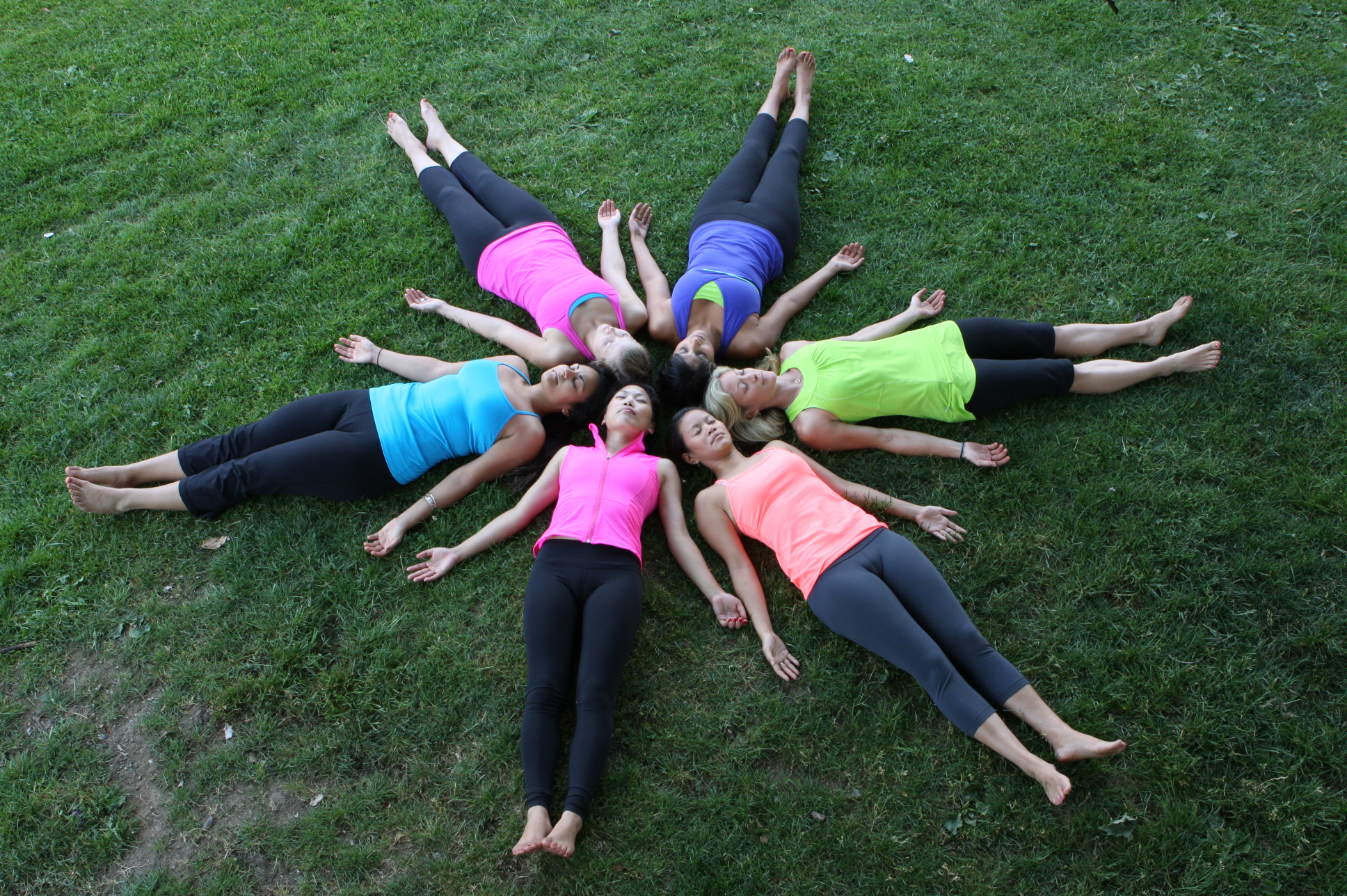
This is an easy one – lie down! What’s the best lying-down pose around? Savasana.

Group Savasana

A group savasana. Photo by Lululemon Athletica (Flickr)

Lie down. Relax.

Performance-Enhancing Yoga Postures – part 1

A few months ago there was a great article on PsyBlog called 10 Simple Postures that Boost Performance. It’s a quick and dirty overview of the fact that while we’ve always known that our moods impact our body language, our body language also impacts our moods (and thus, according to them, our behaviour).

If you haven’t already pondered this truth, try your own little home experiment. Sit up nice and tall, shoulders back, head looking straight forward. How do you feel? Probably pretty good. Now slump your shoulders forward, hunch your back, and look down. Now how do you feel? Besides a little tension in your back, probably a little more down, maybe less confident. It’s subtle, you probably aren’t going to bring yourself out of a deep depression by sitting up straight, but it certainly has an impact.

In yoga, we put our body into different positions and experience what that does to us. I’m going to take a look at a couple of their suggestions, and match in some yoga poses.

Yep, this will be a series, so consider this part one.

Power

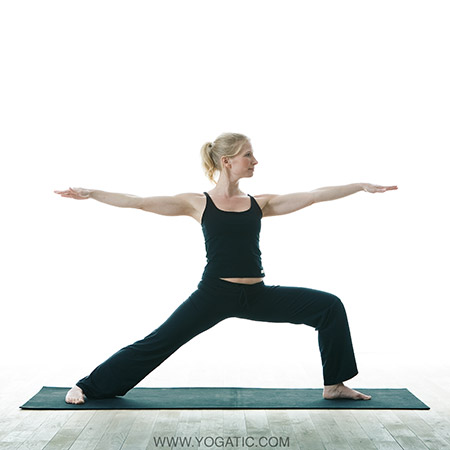
They suggest extending your limbs in a wide, expansive pose to feel more powerful. How about Warrior II?

It’s called Warrior for a reason. With your feet planted strongly into the earth and your arms extended straight out to the sides, feel the warmth and power in your belly that radiates in and out with each breath.

Willpower

They suggest tensing your muscles to increase your willpower. Firm, strong muscles may decrease your experience of pain and help you resist temptation. A good pose that will get all your muscles nice and firm? Chaturanga dandasana.

Chaturanga dandasana is a very challenging pose, and one thing I can tell you for sure is that your muscles will be firm. Don’t forget to breathe, though! It’s easy to get a little too tense in this pose – feel your external muscles strong and firm, while your insides stay soft with room for breath.

Hope Right Now

There is a wonderful article in this weekend’s Vancouver Sun titled ‘Biology of hope’ bolsters Easter’s central message. A thoughtful look at hope and what it means within a religious, psychological, sociological, and even political context.

Some quotes that really stood out for me in this article:

“Hope reflects the capacity for one’s loving, lyrical limbic memory of the past to become attached to the memory of the future.”

“Hope is ‘a desire that is believed possible of realization.'”

Hope is the ability to envision a future in which we wish to participate.”

“Wishing are words and left brain. In contrast, hope is made up of images and is rooted in the right brain. Wishing on a star takes no effort. Hope often requires enormous effort and shapes real lives.”

“In the end, perhaps the most important thing to remember about hope is that it is no walk in the park. It is not the same as optimism, which Larsen correctly says can be Pollyanish. It is not based on impossible dreams or magic wands. It is a virtue to be developed.”

The article goes on to discuss a balance between hope, which is future-based, and the importance of living in the moment. A balance that is beautifully represented in the practice of yoga.

Why do we practice yoga? For a strong and healthy physical body that will carry us through out lives. For enlightenment. For peace of mind and patience. For self-awareness. We practice for many reasons – most of which are rooted in the future. The practice of yoga is, in a sense, the practice of hope. As we work in a pose or practice pranayama, we have hope that it will bring us closer to a future in which we want to participate.

At the same time, yoga is a practice of living in the moment. We intentionally focus our mind inward on what we are experiencing every step of the way. The goal isn’t necessarily to get your body into whichever pretzel shape you’re aiming for, but to experience the journey of what it means to try to get there.

I don’t know about the rest of you, but I find this to be one of the most challenging things I have ever attempted to do. My brain wants so badly to jump ahead to the next step every time – it is constantly writing and re-writing the story of my life. However, when I do manage to let go of that story and actually experience the moment I’m living in, there is a wonderful sense of peace and joy to be found, and one of the best places I’ve been able to do this is on my yoga mat.

So through the practice of yoga, we can simultaneously experience hope for the future and the joy of living in the moment.

Reasons to Avoid Yoga

The number one reason people tell me they can’t do yoga: “I’m not flexible enough.”

To respond to this, I would like to reference a lesson I learned from Getting Things Done, by David Allen. A book on time management, in his introduction he discusses the reasons why people often avoid planning for the future: they don’t have enough time. His response is that you’ll never have enough time. Waiting until you have enough time to plan ahead is like saying that you’ll wait you lose some weight to go on that diet.

Saying you can’t do yoga because you’re not flexible enough is the exact same thing. Let me tell you right now: being inflexible is the whole point!

I get it, going to a class full of young people (mostly women) who are already fit and flexible is intimidating, so here’s a few tips:

  • Only look at your fellow classmates if you’re unsure what you’re supposed to be doing and need to follow along. Comparing is exactly the opposite of what yoga is all about. Also, they might be doing it wrong, or pushing their bodies out of alignment for the sake of going further into the pose.
  • Keep your focus internal – yoga is about your personal experience in the pose.
  • Remember that every body is constructed differently and that your bone structure has a huge impact on how your body will look in a pose. Again, this makes comparing kind of pointless.
  • If you can afford them, take private lessons. You’ll learn the basics and feel secure moving on to group classes if you want to.
  • Try a DVD or online yoga class – I can honestly say from experience that you will not learn as much or go as far without an in-person instructor, but you can at least familiarize yourself with the basic poses on your own.  Just be careful – it’s much easier to injure yourself if you are a beginner practicing alone at home!
  • Most studios offer beginner level classes that will be full of people just like you!
  • Listen to your body!  No yoga instructor will get upset with you for taking a child’s pose if you need a rest, and always pull back a step if you feel any pain.
  • Let your instructor know if you are a beginner, either to yoga as a whole or to the particular style of yoga taught in that class.  They will know to keep an eye on you and offer modifications if you need them, without singling you out in front of everyone.

Yoga: A Good Romance

I think it’s about time for me to tell a little bit of my story and my journey with yoga.

I started doing yoga when I was a teenager, to help my dance training. I was always a little behind the rest of my dance classmates when it came to technique, and I saw in yoga a practice that increased strength, flexibility, and balance. Well, those are three pretty good things to improve for your dance technique! I jumped right in.

Unable to afford yoga studios (although I’m not even sure if there were all that many yoga studios in my suburban town at that time), I bought a videotape of a 30 minute yoga practice and did it almost every day. It was awesome – I loved holding the poses, getting the stretch and the strength. I learned things about aligning my body that I had never learned in dance class. And, since I was doing it at home, I didn’t have to be embarrassed about my level of flexibility. In fact, my family was usually impressed by how far I was stretching so I got a bit of an ego boost from it.

I kept going like this for years. I developed a basic routine that was a mixture of yoga and dance exercises that took about 1-1.5 hours that I did almost every evening during university while watching TV (usually The Daily Show and The Colbert Report). Every once and a while I would take another class at school or elsewhere adding whatever I learned to my home practice.

A wonderful thing happened throughout my years of mindless yoga practice, in front of the TV in my living room, before I embraced a single thing about mindfulness in practice or breath work: my body moved from being an enemy to an ally.

You see, throughout all my years of struggling with nailing dance technique (something that did, in fact, improve with my yoga practice), I learned to blame my body for my shortcomings: any trouble I had in a ballet class was the fault of my stupid body. When my legs didn’t lift as high as the others in develope, when I stumbled through a pirouette, struggled to get into the splits, or fell out of a long-held arabesque, I cursed my frustrating, useless body for the things I couldn’t do.

The thing is, I was no better at yoga than I was at dancing. In fact, with yoga there’s probably even more I can’t do. The difference is that in yoga, that’s the whole point. The goal isn’t to master a pose, but to work on a pose. It’s not to show off how flexible you are but to feel where your limitations are. Somewhere along the line, I managed to embrace this notion without even realizing it. I grew to love the tight feeling in the back of my legs when I do my first forward bend of the morning and can barely reach the ground. I learned to laugh when I fell out of tree pose and to appreciate the beauty of a body in perfect alignment over a body that’s launched itself farther into a pose. I learned to work with my body instead of fighting against it.

That is when I truly began to fall in love with yoga.