Yoga History Flowchart

I love myself a good flowchart, and was thrilled to come across this one! Titled “An Overly Brief and Incomplete Yoga History”, I found it on a lovely yoga blog called Yoga Dork, and they got it from Alison Hinks Yoga. What fun!

Yoga Flowchart

Chart by Alison Hinks

If you’re not already familiar with these names and philosophies it’s going to be a little confusing. Here’s an equally brief and incomplete glossary of terms:

The Bhagavad Ghita: A spiritual text describing several different aspects of yoga, revolutionary for its time (as well as the current time) as it made yoga available to everyone.

Patanjali’s Yoga Sutras: One of the first texts describing the practice of yoga – this predates the physical practice of yoga and the only reference to an asana (yoga pose) is that you should find a “sturdy, comfortable seat” in order to meditate.

Krishnamacharya: An influential yoga teacher who is often credited as the grandfather of yoga in the west as his students brought the practice to England and North America, spawning many sub-practices including power yoga, restorative yoga, anusara, and more.

Workshop: Dances (with)(in) Nature

A few weeks ago I had the opportunity to teach some yoga classes at the wonderful Northern Voice 2011 Conference. It’s a social media conference, but I was lucky enough to meet a fellow yoga instructor there, Clarity Jones! She has a yoga studio, Moonhill Studio, on Cortes Island and is hosting a dance workshop that sounds kind of incredible.

DANCES (with)(in) NATURE
An experiential workshop to physically embody the archetypal flow and form of the natural environment.
July 11-16

This workshop is for dancers, actors, writers, psychonauts, and those whose curiosity hungers for visceral connection between the landscape and the senses. A fun hands-on experience suitable for people fo all levels of dance experience.

Using elements of physical theatre, Butoh dance and contact improvisation we investigate the capacity of the landscape as a point of departure. Through dance, movement and interaction we will make our bodies receptive to our inner and outer nature. Our laboratory will include the studio and the natural spaces of beautiful Cortes Island, BC.

Cost: $350 before June 1/$425 after
Accomodation and camping options are available

Contact: cortescastaways@gmail.com / 604-838-2342

Performance Enhancing Yoga Postured – Part 3

The third installment of my series in response to PsyBlog’s post on 10 Simple Postures that Boost Performance!

Now, we’re going to have to cheat here a little bit, because their fifth posture is sleeping, and I’ve already given Savasana as a pose, and Savasana isn’t really sleeping anyways. So for this one, you’re just going to have to give me a little leeway. And maybe take a nap while you’re at it, because it will help boost your cognitive performance.

Persuasion and Understanding

According to the good folks at PsyBlog, hand gestures that clarify what you’re saying can help you out when it comes to persuading someone of your point. My guess is that when you do something like point to your wrist when asking for the time (even though most peoples’ time-keepers are cell phones these days) or point behind you when talking about the past, a person will follow what you’re saying more easily and take you as an authority. Now the question becomes, how do we fit this into a yoga pose? Most poses are static, and you certainly aren’t talking and explaining points to others while practicing yoga. However, if you practice a pose that has a literal hand motion to go with it, or add hand motions to your practice, you are also practicing integrating intentional gestures into your life. To experiment with this, try Vrksasana, or tree pose.

Andrea in Tree Pose

Photo by Adam Schellenberg

Yep, that’s me, doing a very dramatically-lit Tree Pose. Once you’ve firmly planted your foot on the inside of your leg (anywhere on your leg is fine, even balancing your toe on the ground with your heel on your ankle, if you need to – just don’t push your foot into your knee), your arms are free. Press your palms together in front of your heart and think about what message your body is sending. Extend your arms over your head and see what happens when your hands come together, index fingers pointed up, versus hands open to the sky. What is your body indicating to the world? What else can you do with your arms to show your tree-ness?

Performance Enhancing Yoga Postures Part 2

Part two of my series in response to PsyBlog’s article on 10 Postures the Boost Performance! Check out part one here, and now read on to find more yoga poses that correspond with the research.

Persistence

Research shows that crossing your arms can help fuel persistence – participants who crossed their arms while solving a problem spent up to double the amount of time working on solving it than people who didn’t cross their arms. So, a good arm-crossy yoga pose for you? Try Eagle Pose (Garudasana).

Eagle Pose

Photo by lululemon athletica (Flickr)

To get your arms tangled in this position, extend them straight out to the sides, then sweep them in front of you, with the same arm crossed underneath as the leg that is crossed on top. Then, keeping your elbows together, turn your forearms up and cross your hands. See? Clear as mud! You can bring “Eagle Arms” into other poses as well, from a seated easy pose, to shoestring, warrior 3, and more. If your arms are free in a pose, see what happens if you twist them up a little. Just make sure you keep your shoulders down and together on your back.

Insight

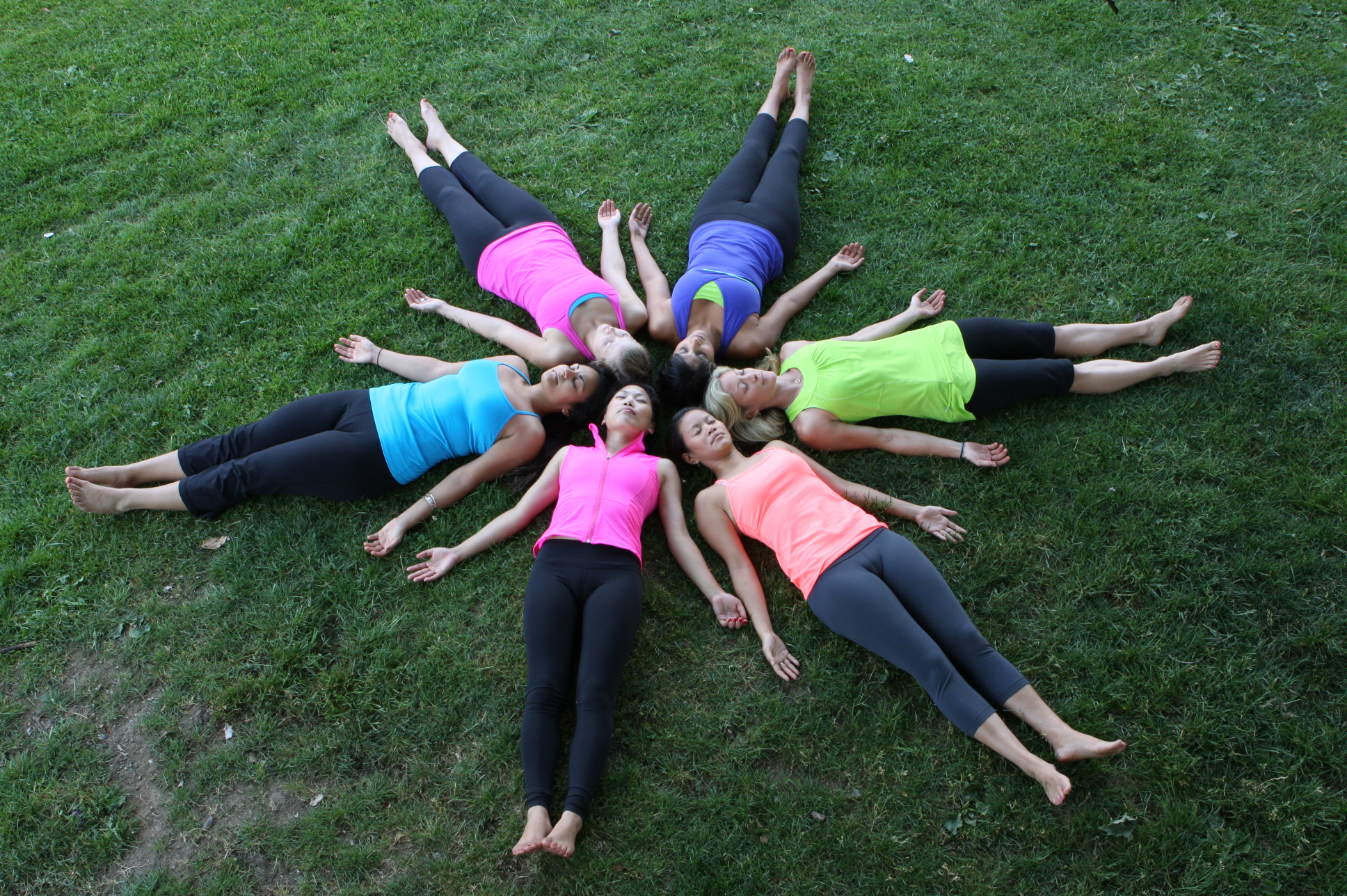
This is an easy one – lie down! What’s the best lying-down pose around? Savasana.

Group Savasana

A group savasana. Photo by Lululemon Athletica (Flickr)

Lie down. Relax.

Neti Pots – weird or wonderful?

Most people these days have at least heard of a neti pot. I learned about these strange devices at yoga teacher training. Basically, it’s a tiny, adorable teapot that you fill with lukewarm water and a little non-iodized salt to clean your sinuses with. I know, right? Sounds weird and terrifying.

I considered getting one right away and trying it out (I think being in yoga teacher training automatically makes you game for trying new things), but since trying neti pot meant going out and buying things first, I never got around to it. Well, I’m here today to announce that a post on the online women’s magazine The Hairpin has inspired me to give the neti pot another level of consideration.

A snippet of their blog post:

So what exactly is a neti pot? It is a cute little pitcher that’s usually shaped like what I imagine a genie’s lamp looks like. You fill it with salt water, and then pour the water into one nostril, which is easier and less terrifying than it sounds. Gravity then pulls the water through your sinuses and it comes pouring out of your other nostril, along with a bunch of goop it’s collected along the way. Yes, it may sound a little unpleasant, but I promise it doesn’t hurt, and once you get the hang of it, it actually feels good! It’s a practice that has been used for centuries in India and has become ever more popular in the United States. (Dr. Oz even talked about it on Oprah, so you know it’s legit.)

Why would you want to flush your sinuses out with salt water? Lots of reasons: it helps clear congestion during a cold (and can make them go away faster), it can prevent and treat sinus infections, reduce allergies, help you breathe more easily, and just generally keep your respiratory system in better health. Neti pots work because they remove the dirt and bacteria and the dried mucousy clumps which like to hang out in your precious nasal caves and cause problems. The water can reach places you can’t get clear simply by blowing your nose or reaching in with your finger (which you would never do, of course). So even if the idea of pouring water into your sinuses sounds icky, just remind yourself that tiny bacteria making a nice home in your face is even ickier. Hey, you clean your mouth and your ears out, why not treat your sinuses with the same respect?

This external validation of the neti pot has inspired me to give it another go. So this is my promise to you: I will try the neti pot and give you a report from the front lines.

Performance-Enhancing Yoga Postures – part 1

A few months ago there was a great article on PsyBlog called 10 Simple Postures that Boost Performance. It’s a quick and dirty overview of the fact that while we’ve always known that our moods impact our body language, our body language also impacts our moods (and thus, according to them, our behaviour).

If you haven’t already pondered this truth, try your own little home experiment. Sit up nice and tall, shoulders back, head looking straight forward. How do you feel? Probably pretty good. Now slump your shoulders forward, hunch your back, and look down. Now how do you feel? Besides a little tension in your back, probably a little more down, maybe less confident. It’s subtle, you probably aren’t going to bring yourself out of a deep depression by sitting up straight, but it certainly has an impact.

In yoga, we put our body into different positions and experience what that does to us. I’m going to take a look at a couple of their suggestions, and match in some yoga poses.

Yep, this will be a series, so consider this part one.

Power

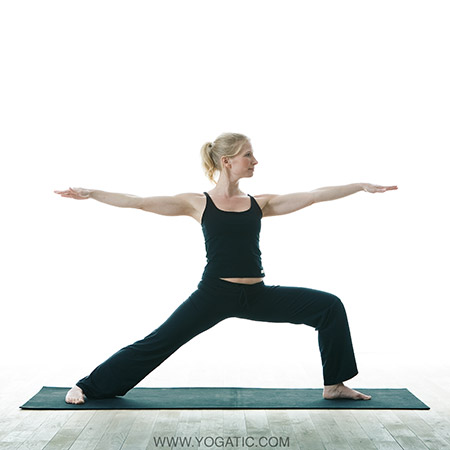
They suggest extending your limbs in a wide, expansive pose to feel more powerful. How about Warrior II?

It’s called Warrior for a reason. With your feet planted strongly into the earth and your arms extended straight out to the sides, feel the warmth and power in your belly that radiates in and out with each breath.

Willpower

They suggest tensing your muscles to increase your willpower. Firm, strong muscles may decrease your experience of pain and help you resist temptation. A good pose that will get all your muscles nice and firm? Chaturanga dandasana.

Chaturanga dandasana is a very challenging pose, and one thing I can tell you for sure is that your muscles will be firm. Don’t forget to breathe, though! It’s easy to get a little too tense in this pose – feel your external muscles strong and firm, while your insides stay soft with room for breath.

Yoga for Geeks – Northern Voice 2011

I’ll be teaching two yoga classes for Northern Voice 2011 this year! Here is their blog post about it:

Your body, bend it, you will. Get in touch with your inner spiritual self, you must. Oh, wait. I’m confusing Yoga and Yoda.

Have fun with Yoga For Geeks each morning of the conference. Bend, twist and move in a way that’s going to get your blood flowing, your lungs breathing and your soul thriving.

Just one more way we’re bending the definition of conference. Ooooommmmm…

Update: This is the second time a yoga session will be held at Northern Voice. This time around, it’s the wonderful Andrea Loewen who will be leading the attack on inflexibility and tension.

Go to the actual post to watch an awesome video with their past yoga teacher, Sarah Pullman.

Election Day!

If you live in Canada, today is a big day. Election day!

Cue the lights, cue the music, cue the voter turnout!

Voter apathy is a huge problem here in Canada. The last election had incredibly low turnout at the polls, especially among young people.

I’m not going to go into all the reasons why people don’t vote and my views on how the electoral system could be made better because, well, there is a time and a place for that, and I’m pretty sure that time and place was the political science paper I wrote in first year.

There are a few points, however, that I would like to make about voting.

Point One: There are people around the world right now who are quite literally dying for the opportunity to do what we’re doing here for the third time in six years. Yes, that is an awful lot of elections to have, but isn’t it better than the alternative? Shouldn’t we be enjoying our democratic rights instead of wishing we didn’t have to fulfill them?

Point Two: One of the many reasons I practice yoga is to practice change. There are things in myself and things in the world I’m not all that fond of, and when I practice with dedication, both on and off the mat, I am working towards bettering those things. Voting is part of that. Yes, that’s right, I just made the yoga=voting connection, and I’m not turning back.

Point Three: Know what else is about change? Theatre. Art. We create to make our “what-ifs” a reality and see what they could become. We create to explore where we’re going, where we’ve been, and to envision a better world. (Side note that if you are interested in arts and culture in this election, there is a great post by Rebecca Coleman outlining the arts and culture platforms of the major parties here.)

So vote and speak for your vision of a better world.

Hope Right Now

There is a wonderful article in this weekend’s Vancouver Sun titled ‘Biology of hope’ bolsters Easter’s central message. A thoughtful look at hope and what it means within a religious, psychological, sociological, and even political context.

Some quotes that really stood out for me in this article:

“Hope reflects the capacity for one’s loving, lyrical limbic memory of the past to become attached to the memory of the future.”

“Hope is ‘a desire that is believed possible of realization.'”

Hope is the ability to envision a future in which we wish to participate.”

“Wishing are words and left brain. In contrast, hope is made up of images and is rooted in the right brain. Wishing on a star takes no effort. Hope often requires enormous effort and shapes real lives.”

“In the end, perhaps the most important thing to remember about hope is that it is no walk in the park. It is not the same as optimism, which Larsen correctly says can be Pollyanish. It is not based on impossible dreams or magic wands. It is a virtue to be developed.”

The article goes on to discuss a balance between hope, which is future-based, and the importance of living in the moment. A balance that is beautifully represented in the practice of yoga.

Why do we practice yoga? For a strong and healthy physical body that will carry us through out lives. For enlightenment. For peace of mind and patience. For self-awareness. We practice for many reasons – most of which are rooted in the future. The practice of yoga is, in a sense, the practice of hope. As we work in a pose or practice pranayama, we have hope that it will bring us closer to a future in which we want to participate.

At the same time, yoga is a practice of living in the moment. We intentionally focus our mind inward on what we are experiencing every step of the way. The goal isn’t necessarily to get your body into whichever pretzel shape you’re aiming for, but to experience the journey of what it means to try to get there.

I don’t know about the rest of you, but I find this to be one of the most challenging things I have ever attempted to do. My brain wants so badly to jump ahead to the next step every time – it is constantly writing and re-writing the story of my life. However, when I do manage to let go of that story and actually experience the moment I’m living in, there is a wonderful sense of peace and joy to be found, and one of the best places I’ve been able to do this is on my yoga mat.

So through the practice of yoga, we can simultaneously experience hope for the future and the joy of living in the moment.

Reasons to Avoid Yoga

The number one reason people tell me they can’t do yoga: “I’m not flexible enough.”

To respond to this, I would like to reference a lesson I learned from Getting Things Done, by David Allen. A book on time management, in his introduction he discusses the reasons why people often avoid planning for the future: they don’t have enough time. His response is that you’ll never have enough time. Waiting until you have enough time to plan ahead is like saying that you’ll wait you lose some weight to go on that diet.

Saying you can’t do yoga because you’re not flexible enough is the exact same thing. Let me tell you right now: being inflexible is the whole point!

I get it, going to a class full of young people (mostly women) who are already fit and flexible is intimidating, so here’s a few tips:

  • Only look at your fellow classmates if you’re unsure what you’re supposed to be doing and need to follow along. Comparing is exactly the opposite of what yoga is all about. Also, they might be doing it wrong, or pushing their bodies out of alignment for the sake of going further into the pose.
  • Keep your focus internal – yoga is about your personal experience in the pose.
  • Remember that every body is constructed differently and that your bone structure has a huge impact on how your body will look in a pose. Again, this makes comparing kind of pointless.
  • If you can afford them, take private lessons. You’ll learn the basics and feel secure moving on to group classes if you want to.
  • Try a DVD or online yoga class – I can honestly say from experience that you will not learn as much or go as far without an in-person instructor, but you can at least familiarize yourself with the basic poses on your own.  Just be careful – it’s much easier to injure yourself if you are a beginner practicing alone at home!
  • Most studios offer beginner level classes that will be full of people just like you!
  • Listen to your body!  No yoga instructor will get upset with you for taking a child’s pose if you need a rest, and always pull back a step if you feel any pain.
  • Let your instructor know if you are a beginner, either to yoga as a whole or to the particular style of yoga taught in that class.  They will know to keep an eye on you and offer modifications if you need them, without singling you out in front of everyone.